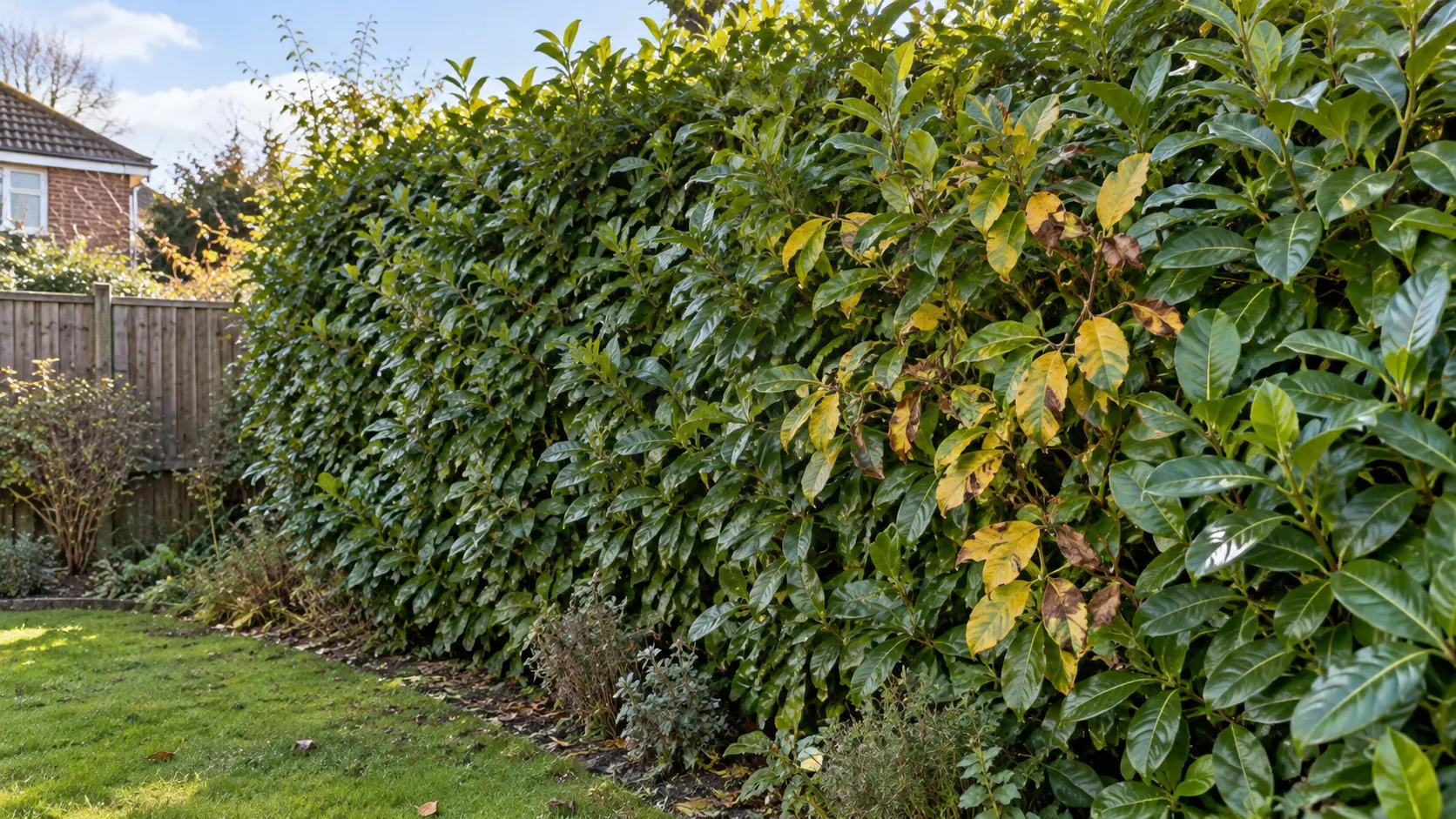


Yellow or brown leaves do not automatically mean your Laurel hedge is dying. First, look at the pattern: are a few older leaves affected, one plant struggling, or the whole row changing colour? Then check the soil around the roots. A dry root ball, waterlogged ground, recent planting and winter damage need different responses, so investigate before adding water, fertiliser or making a heavy cut.
This guide covers Cherry Laurel (Prunus laurocerasus) and Portuguese Laurel (Prunus lusitanica). Bay Laurel and spotted Laurel are different plants, despite sharing the name, and may need different advice.
The appearance of the leaves gives you somewhere to start, but it rarely tells the whole story.
| What you see | Check next | Don’t assume |
|---|---|---|
| A few older leaves inside the hedge turn yellow | Is the outer growth healthy and the change limited? | The hedge is dying |
| Many leaves turn yellow or drop | Is the root area dry, persistently wet or recently disturbed? | It needs fertiliser |
| Leaf edges turn brown and crispy | Has the soil dried out, or has the plant faced hot or cold winds? | Every brown leaf indicates disease |
| One exposed side browns after winter | Is damage concentrated where wind or frost hit it? | The entire plant is dead |
| Leaves develop spots or holes | Are there other symptoms, such as distorted leaves or a white coating? | Every hole has the same cause |
| One plant declines while its neighbours look well | Does that spot differ in moisture, drainage or planting conditions? | The whole row needs treating |
Take a few minutes to compare affected leaves with healthy ones. Note whether the problem appeared suddenly after a particular spell of weather or has been spreading for weeks. That history is often more useful than the colour alone.
Cherry Laurel has relatively large, broad leaves; Portuguese Laurel has smaller, narrower leaves and often reddish young stems. Both can be grown as evergreen hedges, but their foliage can look different after trimming. If you are unsure what was planted, check the original order or compare a healthy section before deciding that a normal characteristic is damage.
Is the change limited to a handful of older leaves deep inside the plant? Does it affect the sunniest or most exposed face? Is every plant struggling, or only the one beside a gate, wall or low-lying patch of ground?
A few yellow leaves on an otherwise vigorous evergreen are less concerning than several plants losing foliage while their shoots die back. If just one plant is affected, investigate its immediate surroundings before treating the entire hedge.
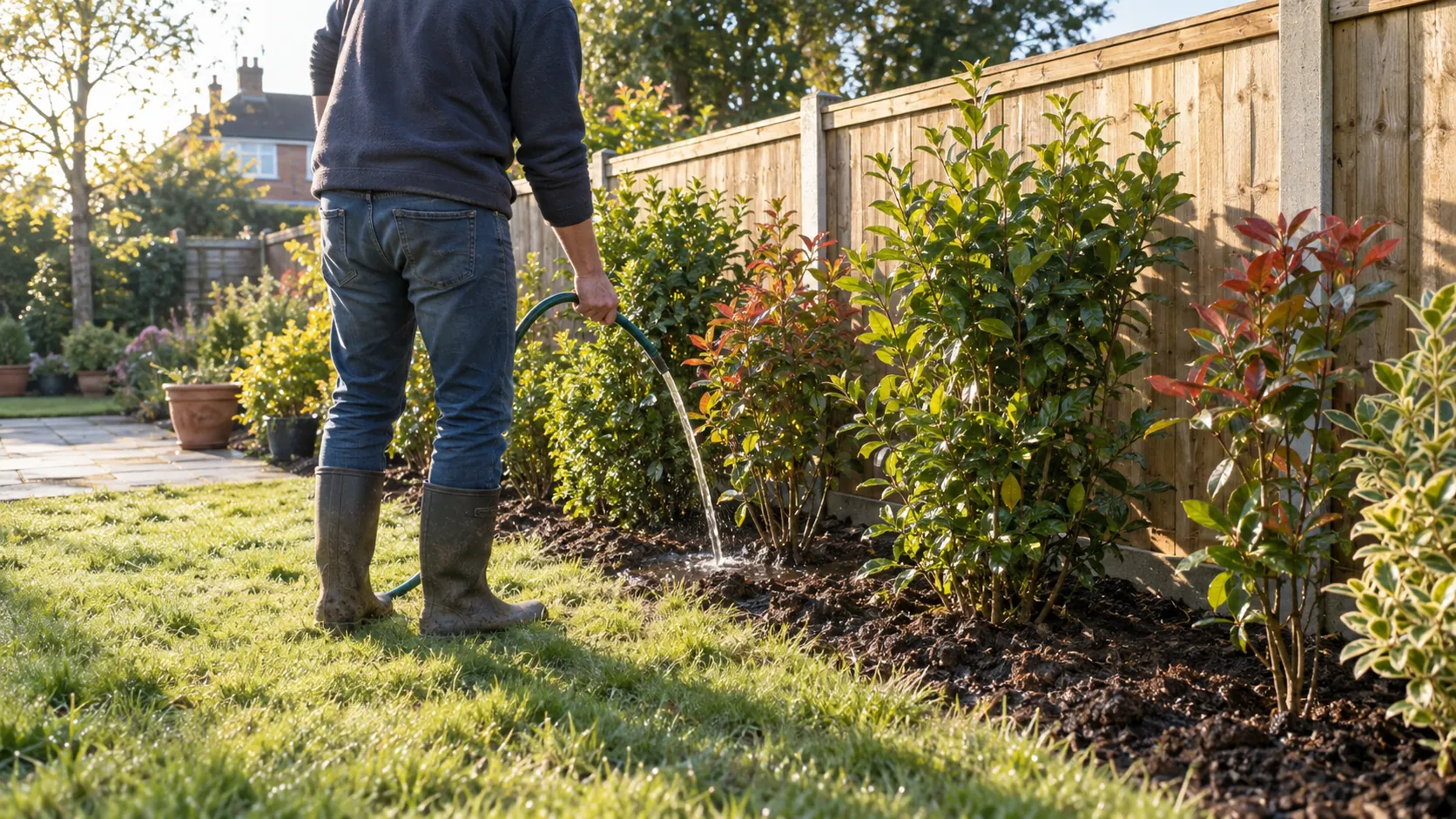
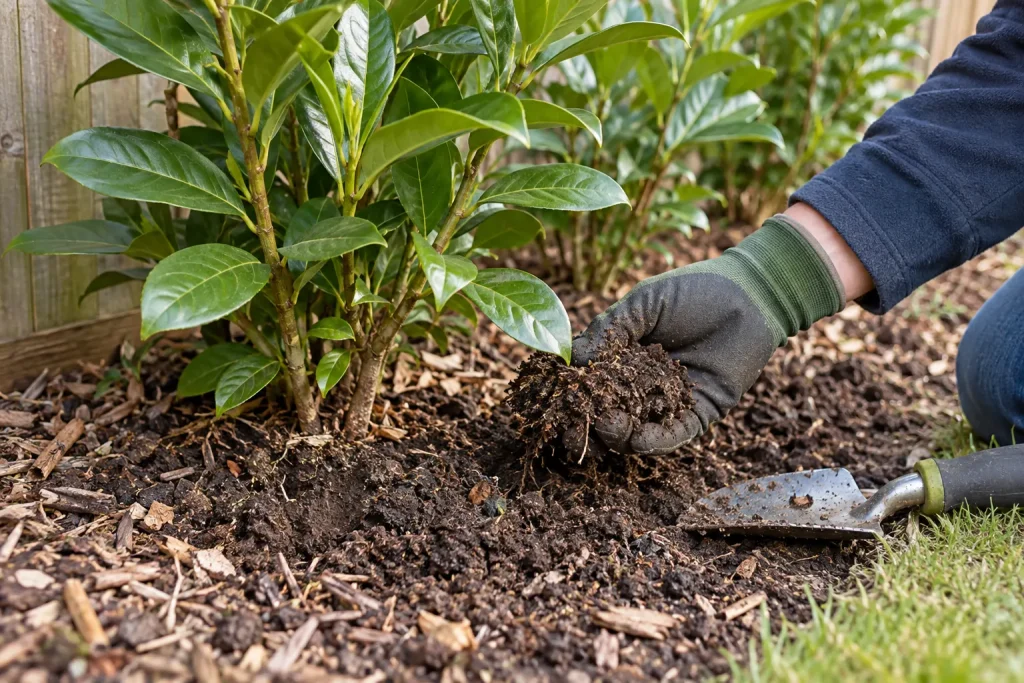
Carefully feel the soil beneath the surface near an affected plant. With a recently planted hedge, check both the original root ball and the soil just outside it: one can be dry while the other feels damp. If the ground is consistently saturated or water stands after rain, adding more water is unlikely to help.
Also look for compacted ground, a nearby downpipe, hard paving that sheds water, or a wall and dense foliage that keep rain away from the roots. Avoid digging through major roots merely to investigate. The aim is to establish whether the root zone is drying out, draining normally or staying wet.
Some older-leaf shedding is normal. If a small number of inner leaves turn yellow and fall while the rest of the hedge is green and making healthy new growth, you may only need to monitor it.
Widespread yellowing needs a closer look. Cherry Laurel yellow leaves and Portuguese Laurel yellow leaves can both be associated with stress around the roots, but the same colour change can have more than one cause.
A newly planted Laurel turning yellow may be adjusting to its new position. Its roots have not yet grown far into the surrounding soil, even if the supplied plant is tall. A few leaves may be shed during establishment, particularly if conditions turn dry or windy. Check moisture in the root ball rather than assuming that rain or a damp-looking surface has reached it.
If the root ball is dry, water slowly around it and allow water to soak into the surrounding soil. If the ground remains wet for long periods, investigate drainage instead. Waterlogged or compacted soil can restrict the air available to roots and interfere with their ability to support the foliage. Yellowing accompanied by persistent wetness, poor growth or progressive dieback deserves particular attention.
Nutrient availability can also affect leaf colour, but yellow leaves on a Laurel hedge are not proof of a nutrient deficiency. Dryness, damaged roots and waterlogging can interfere with nutrient uptake even when nutrients are present in the soil. Check growing conditions before reaching for fertiliser; feeding will not correct saturated ground or a root ball that keeps drying out.
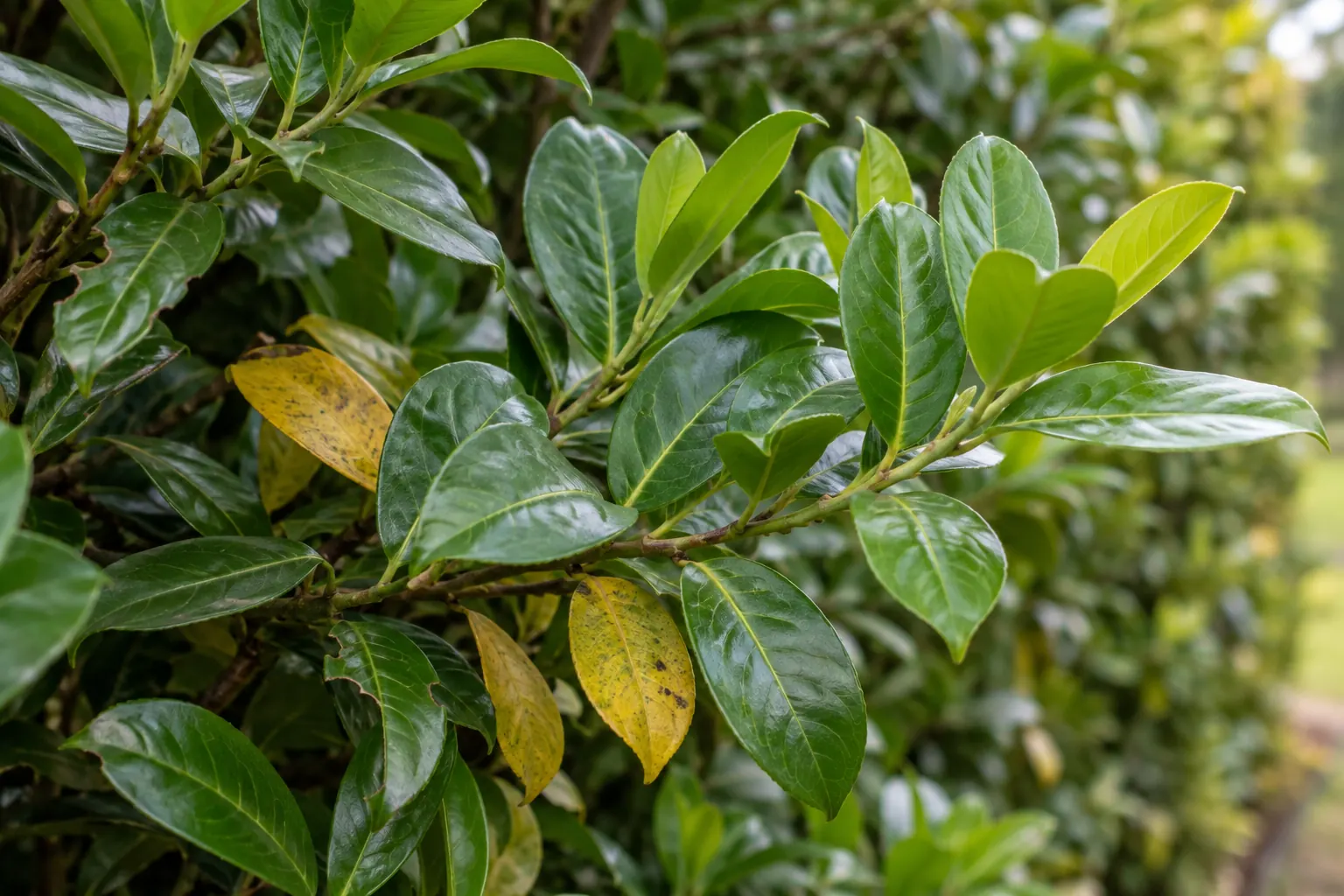
When Laurel leaves are turning brown at the tips or edges, look at their texture and the recent conditions. Crispy margins after a dry spell may point towards moisture stress, especially on a newly planted hedge or one growing beside a rain-sheltered wall. Check the root area before watering: brown edges alone cannot tell you whether the soil is dry.
Wind can also dry exposed foliage. After winter, an outer face that took the brunt of cold winds or frost may show brown patches while growth further inside remains healthy. Give the hedge time to show whether new shoots are developing before deciding that a whole section must be removed.
Brown lines on leaves recently sliced by a hedge trimmer are different again. Cherry Laurel’s broad leaves can develop conspicuous brown cut edges. This is often an appearance issue rather than evidence that the roots or stems are failing. For detailed cutting methods and timing, see our guide to how and when to prune a Laurel hedge.
Progressive browning of entire shoots or stems is more concerning than a few damaged leaves. Check whether the affected branches are still flexible and whether new growth is appearing elsewhere. If dieback continues to spread, especially alongside persistently wet soil or rapid leaf loss, seek a more specific assessment rather than repeatedly watering, feeding or cutting the hedge.
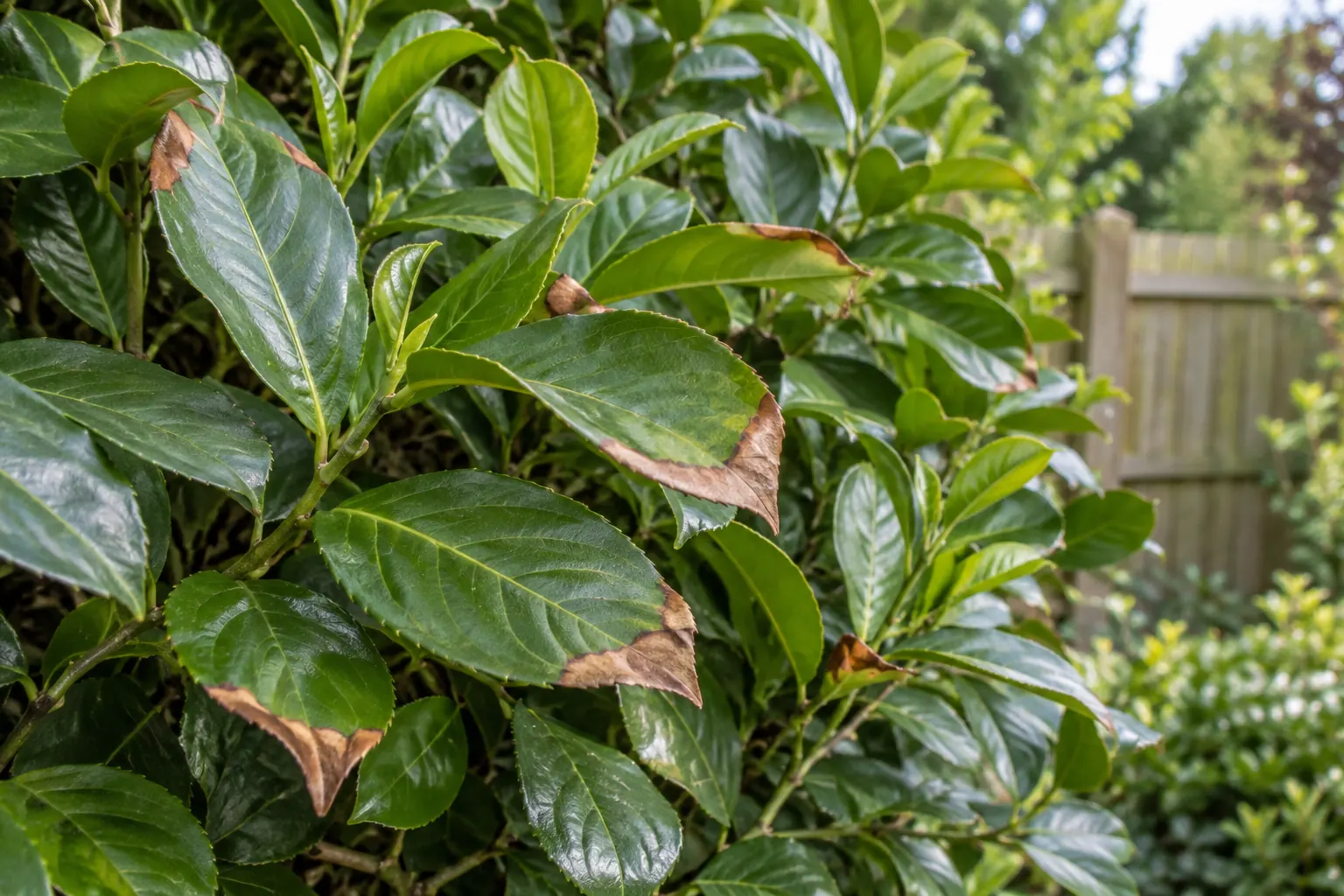
Laurel leaves can develop brown spots, areas of dead tissue that later fall away, or a powdery-looking coating. These symptoms are sometimes described as leaf spot, shot-hole or powdery mildew. More than one problem can produce similar-looking holes, so a photograph of one leaf is not enough to identify the cause with certainty.
Look at several leaves on different parts of the hedge. Are new leaves affected as well as old ones? Is the damage spreading, or are fresh leaves emerging clean? Remove fallen, badly affected debris where practical and keep the hedge’s general growing conditions under review. Avoid an automatic chemical treatment or a severe cut based only on a few spotted leaves.
If spotting is extensive, new growth is repeatedly affected, or leaf symptoms come with substantial stem dieback, get specialist advice. The answer may depend on the plant, site conditions and the exact pattern of damage.
If you are wondering how to revive a Laurel hedge, begin with the cause you can actually establish. A useful recovery plan is less about adding treatments and more about removing the stress.
Recovery is not guaranteed. A hedge with some damaged leaves but living stems may improve as conditions improve; a plant with extensive root damage may not. Monitor the response rather than expecting a particular number of days or weeks.
A single declining plant often points to something local. Compare it with the nearest healthy Laurel. Is its root ball drier? Does water collect in that part of the border? Was it planted at a different depth, or is the ground more compacted? Could a mower, strimmer or other activity have damaged the lower stem?
Check exposure too. The plant at the end of a row may face more wind, while one beneath an overhang may receive less rain. A newly planted Laurel hedge that appears to be dying may have one struggling root ball rather than a problem affecting every plant.
If you cannot find a difference and the dieback progresses, ask a qualified gardening or plant-health professional to inspect it. Treating all the healthy plants because one is declining can create a second problem.
Seek advice if several plants decline rapidly, stems continue to die back, the ground stays saturated, symptoms spread despite correcting obvious issues, or replacements repeatedly fail in the same spot. An uncertain disease or root problem is worth investigating before moving soil or planting more Laurels.
If an individual plant proves beyond recovery, address the underlying site conditions before replacing it. Otherwise the next plant may face the same difficulty. Once the position is suitable, you can compare available Cherry Laurel hedging plants or Portuguese Laurel hedging plants to fill the gap. If you are reconsidering the boundary planting altogether, browse the wider range of hedging plants.
Do not judge recovery by waiting for fully yellowed leaves to regain their colour. Some will fall. Look instead for healthy new growth and whether the yellowing has stopped spreading.
Sometimes. Brown leaf edges or an exposed patch after winter do not necessarily mean the stems and roots are dead. Recovery depends on the cause and how much of the plant remains healthy. Progressive browning of whole branches needs closer investigation.
Check the soil around the roots, not just the leaves. A dry root ball calls for a different response from soil that remains wet and poorly aerated. Both conditions can leave foliage looking distressed.
Some leaf loss can occur while plants establish, but check the root balls and drainage if it is substantial or continuing. Taller supplied plants still need time for their roots to grow into the surrounding soil.
Do not make a heavy cut your first response to an undiagnosed problem. Establish whether the roots are dry, waterlogged or otherwise stressed. Clearly dead growth can be dealt with appropriately, but substantial renovation is a separate decision.
Not necessarily. First check soil moisture, drainage and recent planting history. Fertiliser is unlikely to solve a root problem and should not replace a proper diagnosis.
A Laurel hedge often gives you more clues than its leaf colour alone. Compare affected plants with healthy ones, check the soil around their roots and respond to the cause you find. Then watch for healthy new growth before deciding whether further treatment—or replacement—is needed.