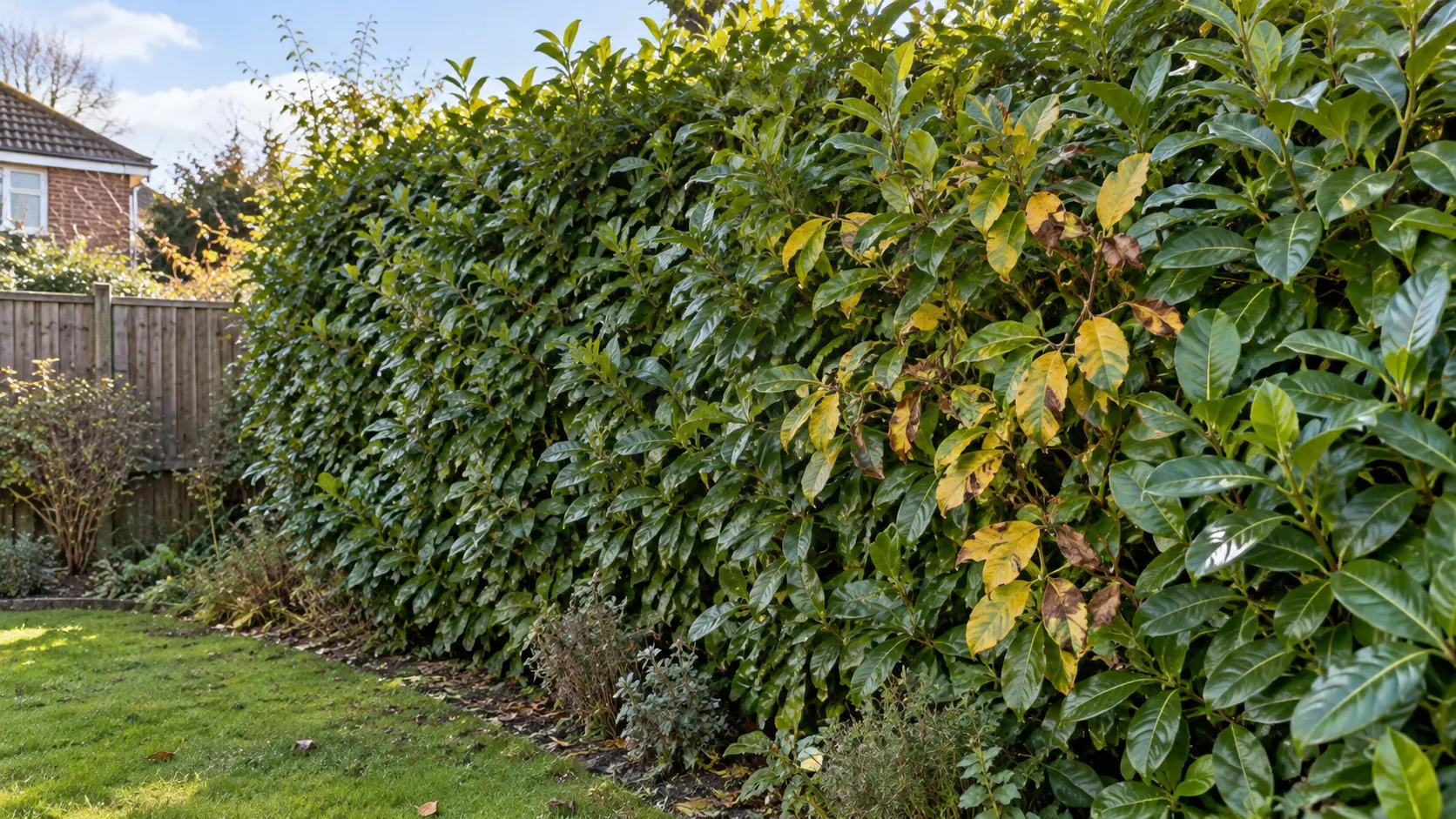


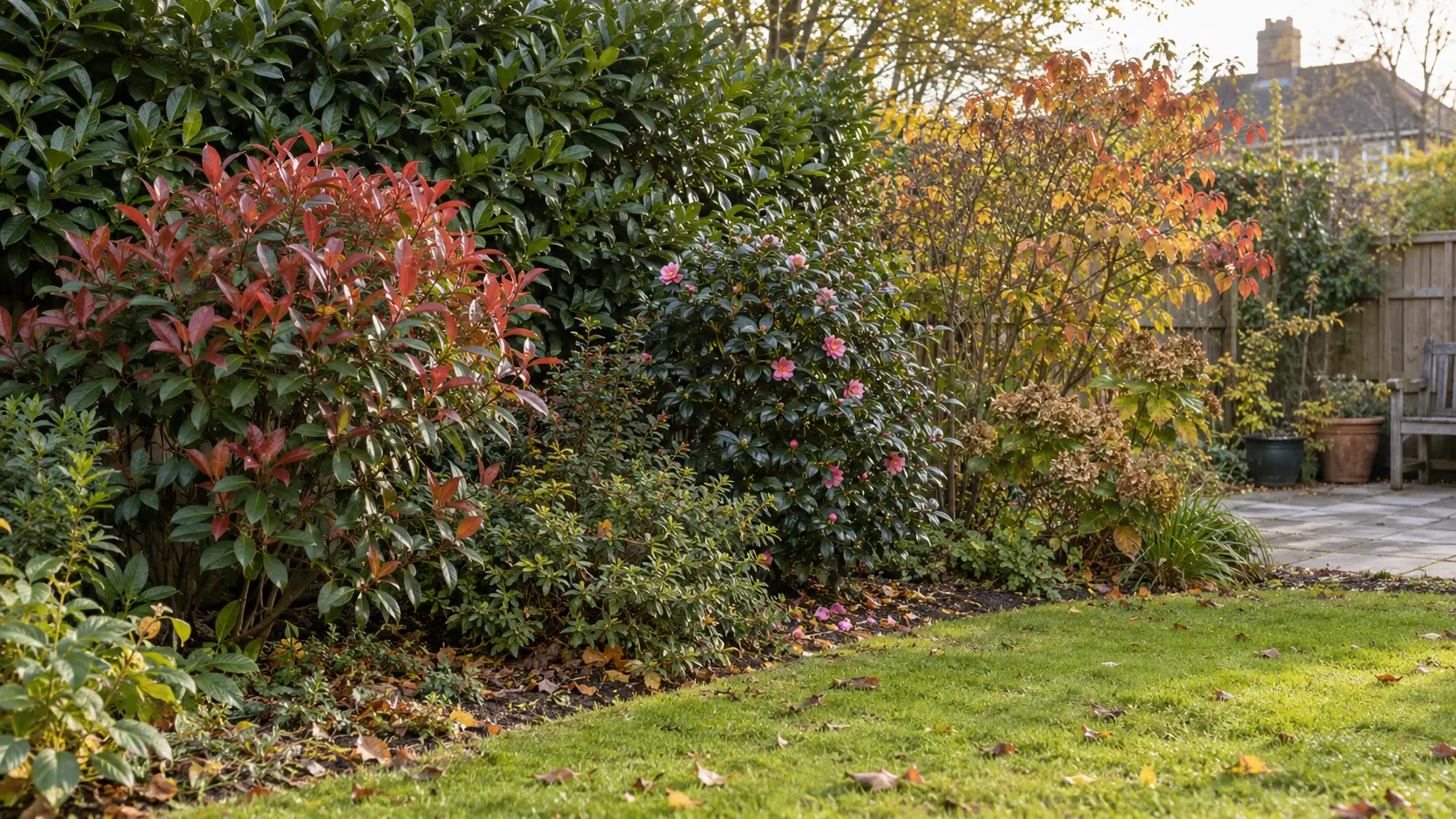
Most garden shrubs and bushes fall into a few useful groups: evergreen, deciduous, flowering, foliage and screening plants. These groups often overlap. Camellia sasanqua, for example, is both evergreen and flowering, while Cherry Laurel can be grown as an individual shrub or planted as a hedge for privacy.
The right choice depends on what you want the plant to do, how much space it will have and the conditions in your garden. In this guide, we compare the main types of shrubs found in UK gardens, including Camellia Sasanqua, Photinia Red Robin, Cherry Laurel and Portuguese Laurel.
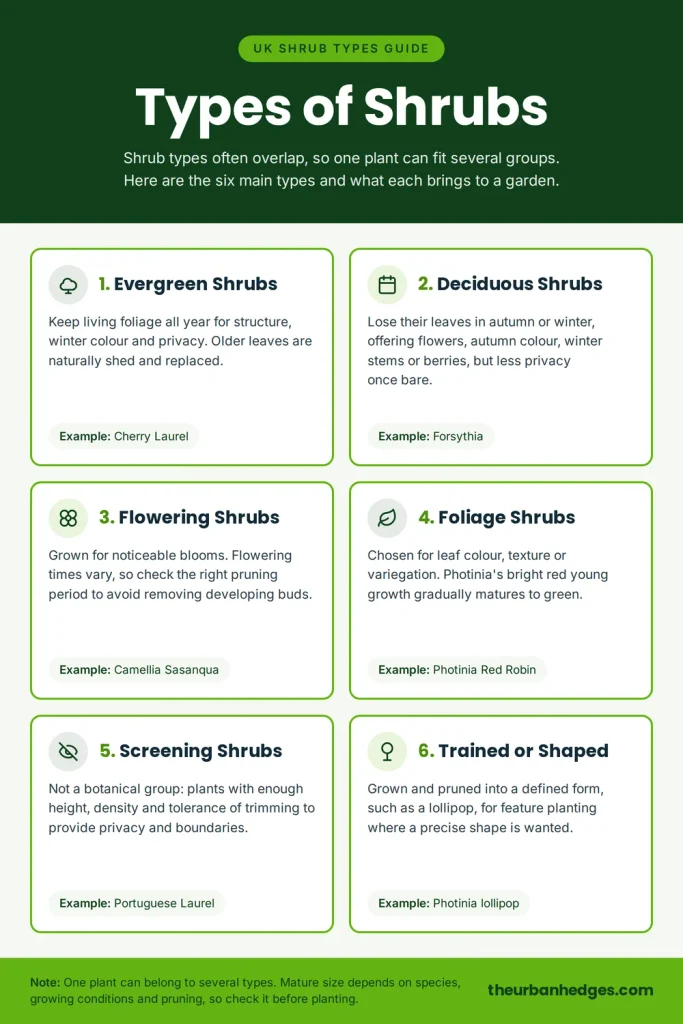
Shrub types at a glance
| Shrub type | Defining characteristic | Typical use | Relevant example |
|---|---|---|---|
| Evergreen | Retains foliage throughout the year | Structure and year-round coverage | Cherry Laurel |
| Deciduous | Loses its leaves seasonally | Flowers, autumn colour and seasonal interest | Forsythia |
| Flowering | Produces noticeable ornamental flowers | Borders and feature planting | Camellia Sasanqua |
| Foliage | Selected mainly for leaf colour or texture | Borders and decorative screening | Photinia Red Robin |
| Screening | Develops enough height and density to provide cover | Privacy and boundaries | Portuguese Laurel |
| Trained or shaped | Grown and pruned into a defined form | Feature planting | Photinia lollipop |
A plant does not necessarily belong to only one category. Photinia Red Robin, for example, is an evergreen foliage shrub that can also form a decorative screen. Understanding these overlaps is more useful than trying to place every plant into a single group.
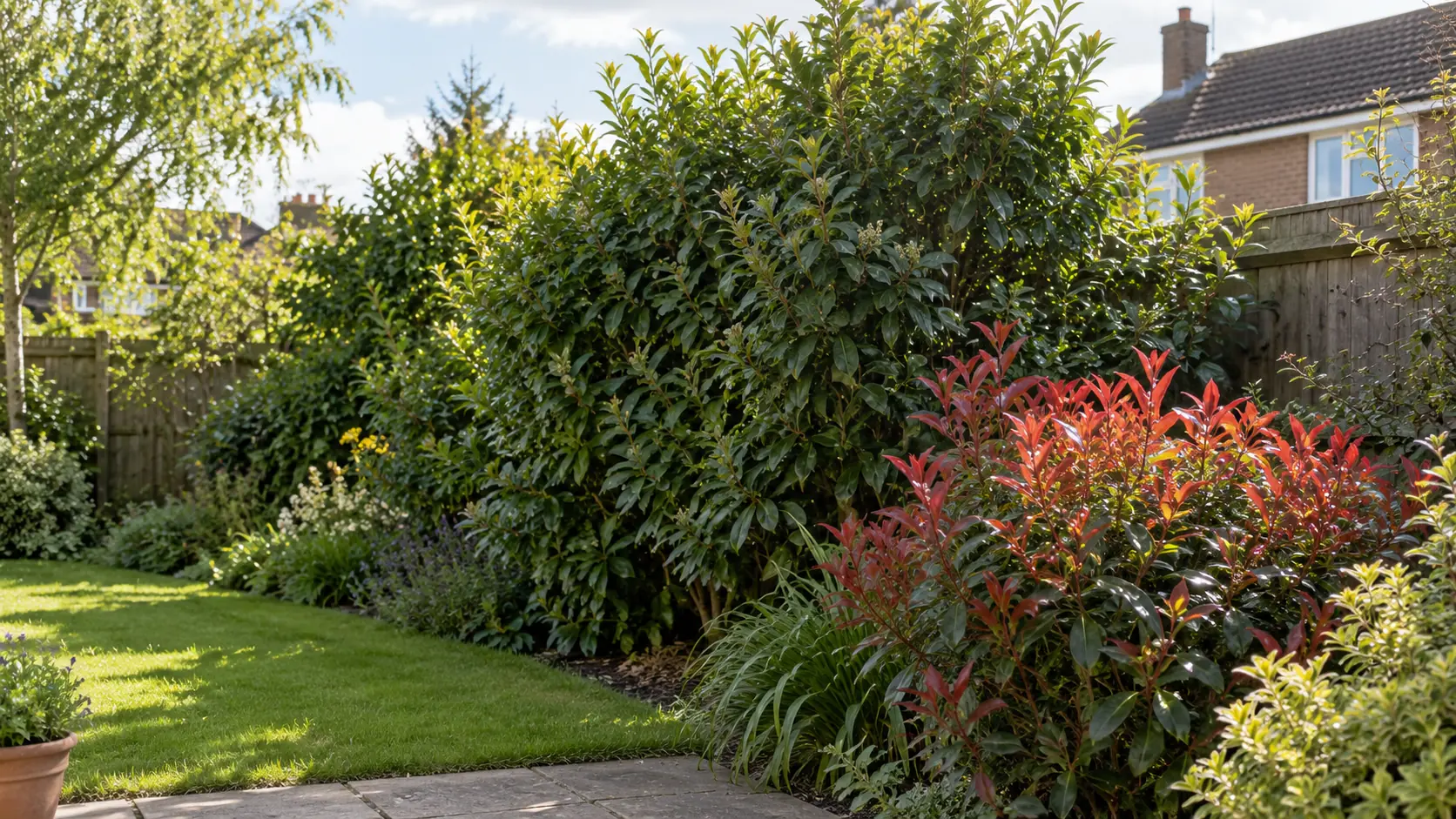
A shrub is a perennial woody plant that normally develops several stems from or close to ground level. Shrubs vary considerably in mature height, spread and growth habit. Some remain compact, while others can develop into substantial plants several metres tall and wide.
Garden shrubs may be selected for their flowers, leaves, berries, stems, form or ability to provide coverage. Some are grown as individual features, while others are planted together in garden borders, hedges and screens.
Bush and shrub are commonly used to describe the same kind of multi-stemmed woody plant. In horticultural writing, shrub is usually the more precise term. Bush often describes the plant’s dense, rounded or spreading appearance rather than a different botanical category.
People searching for different types of bushes are therefore usually looking for the same broad group of plants as those researching different types of shrubs. The phrase “UK bushes” is also commonly used informally when looking for shrubs suited to British gardens.
A shrub describes a type of plant. A hedge describes how plants are arranged and maintained.
Cherry Laurel, Portuguese Laurel and Photinia are all shrubs. One plant can be grown as an individual garden feature, while several can be planted in a row and maintained as a continuous hedge.
If your main objective is to create a boundary or screen, compare plants within the wider range of hedging plants.
Shrubs generally develop multiple woody stems from low down, while trees usually have a more clearly defined main trunk supporting a crown. The distinction is not always absolute.
Some large shrubs can be trained into tree-like forms, while some naturally small trees may develop several stems. How a plant is grown and maintained can therefore be as important as its botanical classification.
One of the most useful ways to compare types of shrub is to divide them into evergreen and deciduous plants. This determines whether the garden retains foliage and screening through winter or changes more noticeably with the seasons.
The different types of evergreen shrubs retain living foliage throughout the year. This does not mean that every leaf remains permanently attached. Older leaves are naturally shed and replaced, but enough broadleaf foliage remains to preserve the plant’s evergreen appearance.
Evergreen shrubs are commonly used for:
Broadleaf evergreen shrubs include Camellia, Photinia and Laurel. They differ from evergreen conifers such as Leylandii and Thuja, which have needle-like or scale-like foliage and respond differently to pruning.
The Urban Hedges’ evergreen shrub range includes plants suitable for ornamental use, borders and screening. The right choice depends on the appearance you want and the conditions available.
Deciduous shrubs lose their leaves during autumn or winter before producing new foliage during the following growing season. Familiar examples include Forsythia and many Hydrangeas, although these are general examples and are not necessarily products stocked by The Urban Hedges.
Deciduous shrubs may provide:
This seasonal cycle can add variety to a planting scheme. However, a deciduous shrub will not provide the same continuous privacy as an evergreen screening plant once its leaves have fallen.
Some shrubs are selected mainly for their flowers, while others are valued for the colour, shape or texture of their leaves. These classifications can overlap because a flowering shrub may also be evergreen or have ornamental foliage.
Different types of flowering shrubs bloom at different points in the year. Some provide spring flowers, others flower during summer, and certain varieties create interest during autumn or winter.
Before choosing a flowering shrub, consider:
Pruning at the wrong time can remove developing flower buds, so flowering shrubs should not all be cut according to one general calendar.
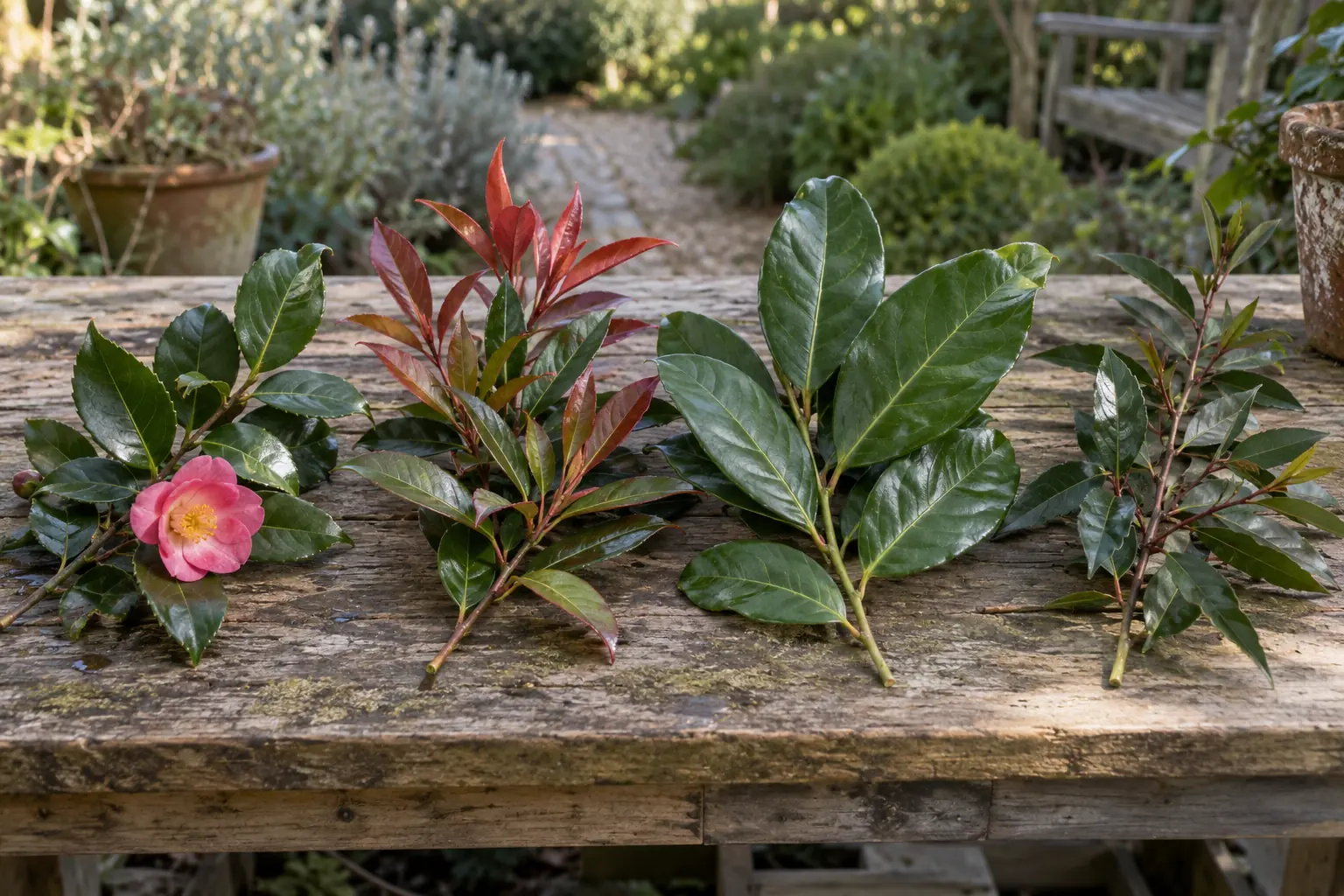
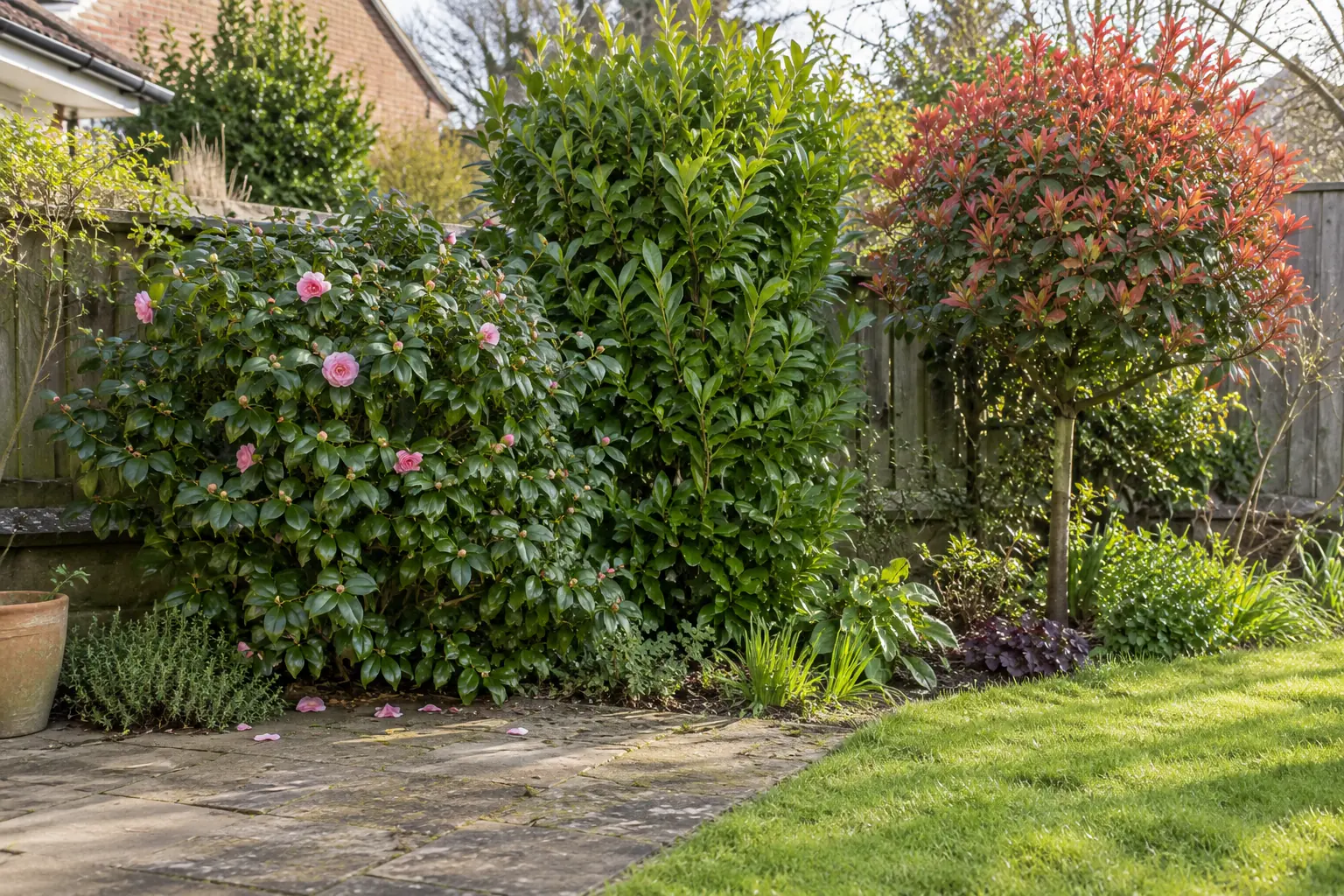
Camellia Sasanqua is a relevant example of a flowering evergreen shrub. It combines glossy evergreen foliage with seasonal blooms that generally appear during autumn and early winter, although precise timing depends on the plant and growing conditions.
Camellia Sasanqua performs best in a sheltered position with moist but well-drained, suitably acidic-to-neutral soil. Where the natural soil is unsuitable, ericaceous growing media may be required for container cultivation. The planting conditions should be assessed before selection rather than after the plant has been positioned.
Foliage shrubs are chosen primarily for the appearance of their leaves rather than their flowers. Their ornamental value may come from:
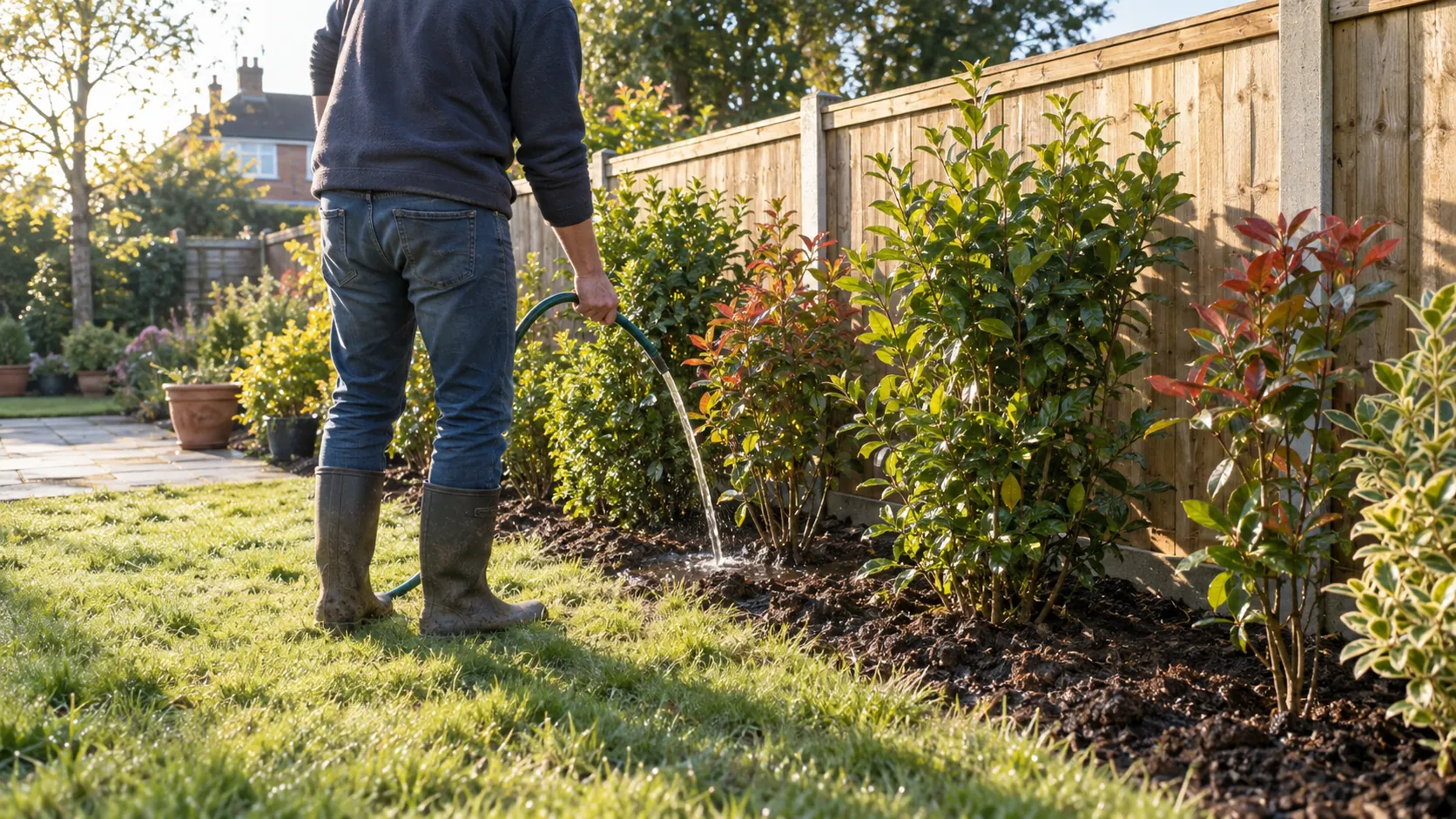
Photinia Red Robin, or Photinia × fraseri ‘Red Robin’, is recognised for the bright red colour of its young foliage. The leaves gradually mature to green, creating a contrast between new and established growth. The familiar red colour comes from its foliage rather than red flowers.
Photinia can be grown as an individual ornamental shrub, incorporated into a mixed border or planted as a decorative screen. Trained lollipop forms can also be used for feature planting where a more defined shape is required. Other shaped plants can be explored through the topiary and trained-tree collection.
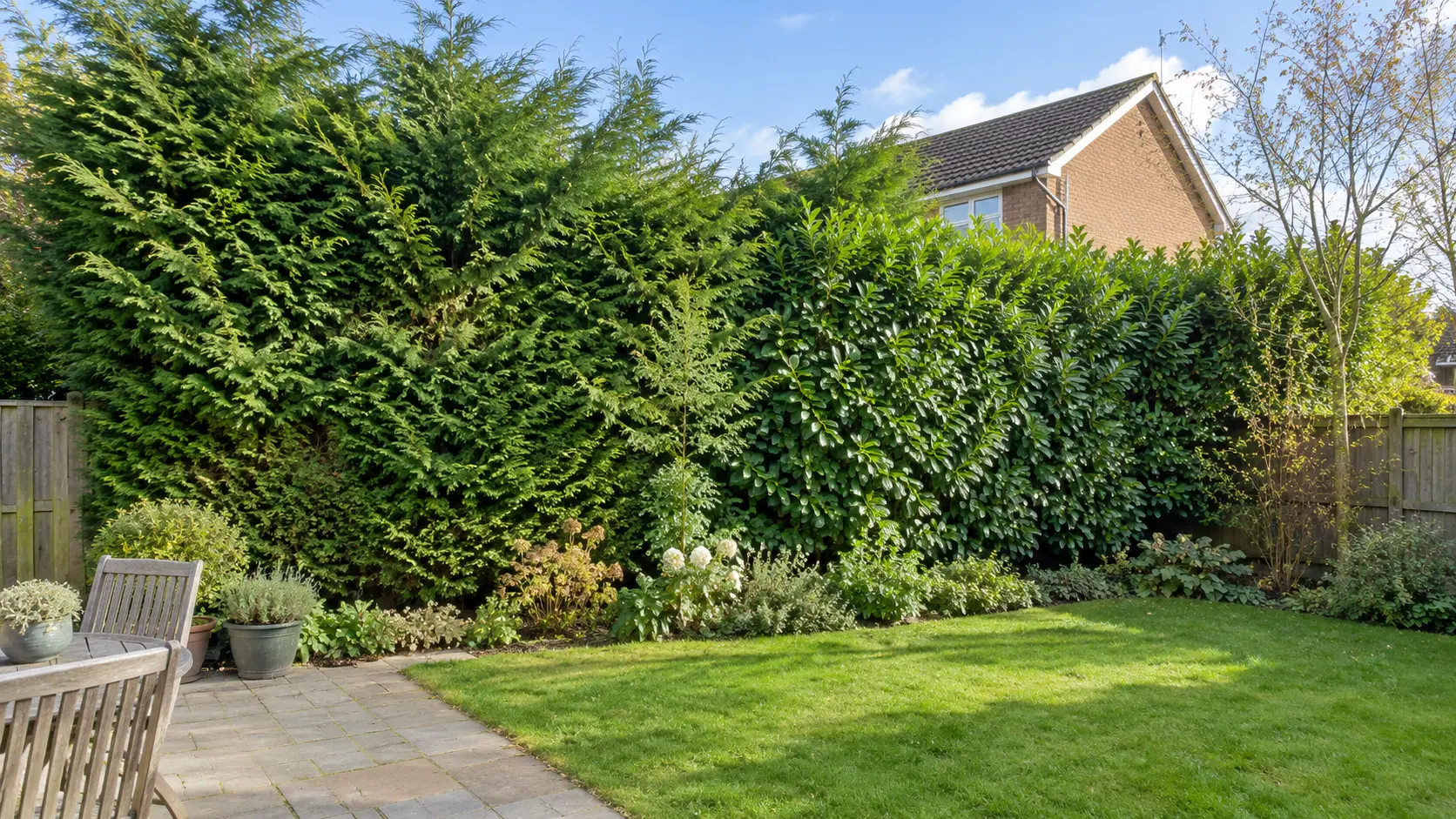
Screening shrubs are selected to reduce overlooking, define a boundary or create visual separation within a garden. They are not a separate botanical group. The description refers to the way their height, foliage density and growth habit can be used.
When comparing shrubs for privacy, consider whether you need immediate presence, year-round foliage or a more decorative boundary.
A suitable screening shrub normally requires:
Evergreen shrubs are normally preferred where year-round privacy is important. Deciduous plants may still form useful boundaries, but their coverage becomes lighter after the leaves fall.
| Shrub | Main characteristic | Best use | Important consideration |
|---|---|---|---|
| Cherry Laurel | Large, dense evergreen leaves | Vigorous informal screening and hedging | Needs sufficient space and regular size control |
| Portuguese Laurel | Smaller evergreen leaves and refined growth | Formal or structured hedging | Requires suitable establishment and ongoing trimming |
| Photinia Red Robin | Evergreen foliage with bright red young growth | Decorative screening and mixed boundaries | Regular trimming affects its shape and flushes of new foliage |
| Camellia Sasanqua | Evergreen foliage with seasonal flowers | Feature planting and informal screening | Requires suitable soil and a sheltered position |
Cherry Laurel, or Prunus laurocerasus, is commonly chosen where dense evergreen coverage is the priority. Its broad leaves create substantial screening, but its mature size and maintenance requirements should be considered before planting.
Portuguese Laurel, or Prunus lusitanica, has smaller leaves and a more refined appearance. It is often selected for structured or formal evergreen boundaries.
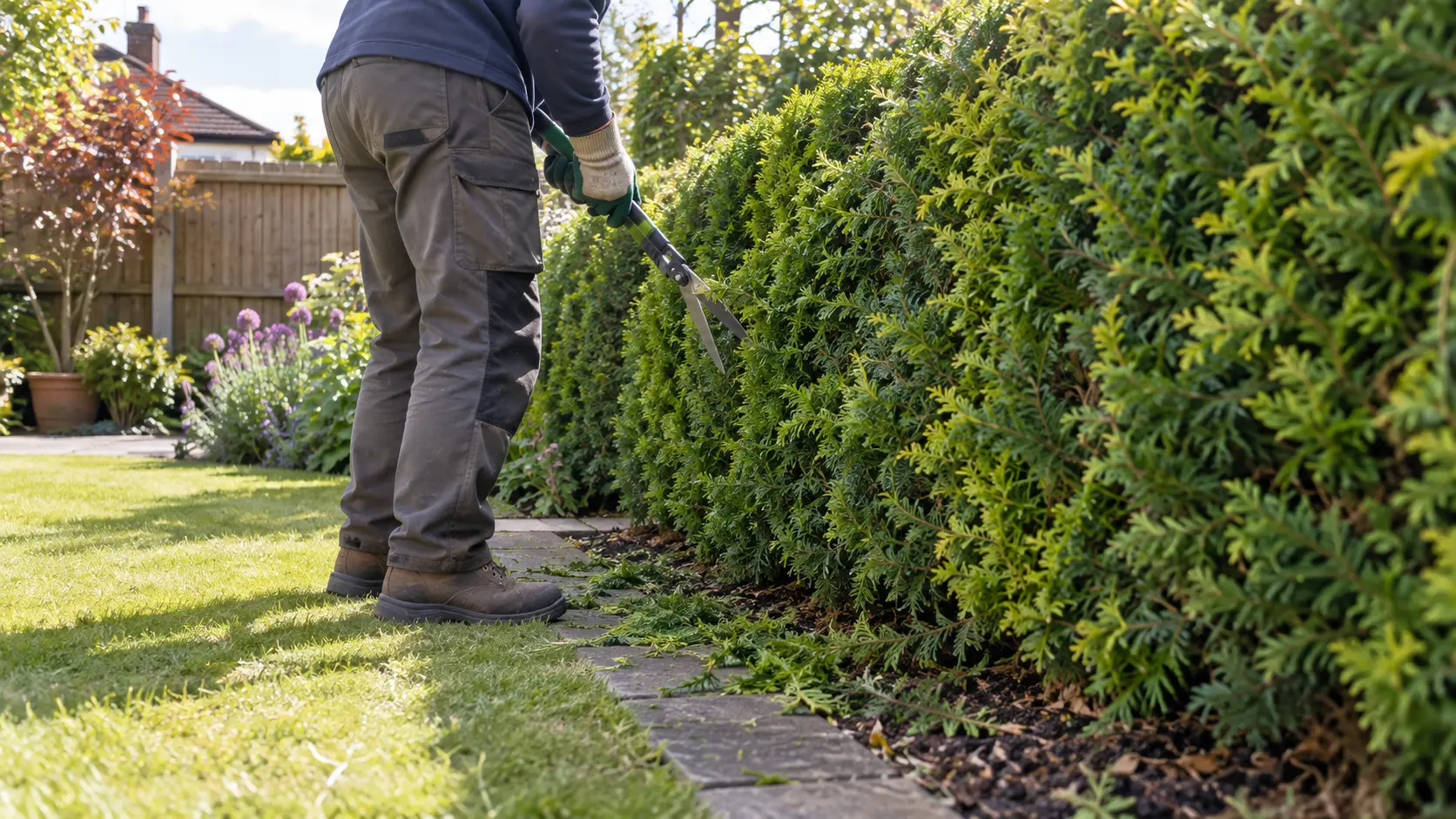
Both plants require ongoing size control. Our Laurel hedge-pruning guide explains their different trimming requirements.
Both are botanically shrubs even when planted and maintained as hedges. Their inclusion in shrub and hedging categories reflects different intended uses rather than different plant identities.
For a detailed comparison of growth rates and coverage, read our guide to fast-growing evergreen trees and hedges for privacy.
Shrubs can also be grouped by mature size and growth habit. This distinction is particularly useful when choosing plants for a small border, an individual feature or a substantial privacy screen.
Compact shrubs generally suit smaller beds, courtyards and containers. Medium-sized shrubs can add permanent structure to mixed borders, while large shrubs may provide considerable height, coverage and visual impact.
A shrub’s growth form may be:
Always distinguish between supplied height and mature size. A plant listed as 150cm tall is approximately that height when supplied; it does not mean it will remain at 150cm.
Mature height and spread depend on the species, cultivar, growing conditions and future pruning. A taller supplied plant can provide greater immediate presence, but it still requires enough room for healthy development.
The right type of bush or shrub depends on what you need the plant to achieve and whether your garden can provide suitable growing conditions.
What do you want the shrub to do?
Start with its intended purpose. A flowering feature plant has a different role from a dense privacy screen. Decide whether your priority is flowers, foliage, structure, screening or a trained ornamental form.
Do you need year-round coverage?
Choose an evergreen shrub if continuous foliage and winter privacy are important. A deciduous shrub may provide stronger seasonal changes but will offer less coverage after its leaves fall.
How much sunlight does the position receive?
Some shrubs perform best in full sun, while others tolerate or prefer partial shade. Buildings, fences and established trees can alter light levels during the day and across the seasons.
For more detailed recommendations, read our guide to the best evergreen shrubs for shade in UK gardens.
What soil and drainage conditions do you have?
Check whether the soil is acidic, neutral or alkaline and whether it drains effectively. Camellias generally need suitably acidic-to-neutral conditions, while other shrubs can tolerate a broader range of soils.
Even plants that prefer consistent moisture may struggle where water remains around the roots. Improve severe drainage problems before planting rather than expecting a shrub to overcome an unsuitable site.
How much space is available?
Check mature height and spread. A plant that fits comfortably when delivered may eventually become too wide for a narrow border or too tall for its intended position.
Allowing sufficient space can reduce competition, improve air movement and make maintenance easier.
How much maintenance is acceptable?
Vigorous growth can provide coverage sooner, but it normally requires more frequent trimming. Formal shapes and tightly maintained hedges also need more attention than shrubs allowed to develop a natural outline.
Consider the mature plant and expected pruning requirements rather than choosing solely for its appearance when supplied.
Choose the shrub that most closely matches your main objective:
One plant may satisfy several requirements, but one characteristic should normally lead the decision. Establish the principal purpose first, then confirm that the shrub suits the light, soil, drainage and available space.
The main types of shrubs include evergreen, deciduous, flowering, foliage and screening shrubs. They may also be grouped by mature size, growth habit or trained form. These classifications overlap, so one plant can belong to several categories. Camellia Sasanqua, for example, is both evergreen and flowering.
Bush and shrub commonly describe the same kind of multi-stemmed woody plant. Shrub is the more precise horticultural term, while bush often refers to a dense or rounded growth habit. Searches for different types of bushes and different types of shrubs therefore frequently share the same intent.
A hedge is not a botanical type of shrub. It is a row of plants grown and maintained to create a boundary or screen. Many hedges are formed from shrubs, including Cherry Laurel, Portuguese Laurel and Photinia, but the same plants can also be grown individually.
Evergreen shrubs retain living foliage throughout the seasons, although individual older leaves are naturally replaced. Camellia Sasanqua, Photinia Red Robin, Cherry Laurel and Portuguese Laurel are broadleaf evergreen shrubs that can provide year-round structure and coverage in suitable UK gardens.
Yes. Flowering describes the plant’s ornamental blooms, while evergreen describes how it retains foliage. Camellia Sasanqua is both a flowering and evergreen shrub, providing persistent leaves alongside seasonal autumn and early-winter flowers.
Cherry Laurel, Portuguese Laurel and Photinia Red Robin can all be used as shrubs for privacy. The best choice depends on the required appearance, available space, growing conditions and acceptable maintenance. Compare them with other hedging plants before deciding.
Suitability depends on the depth of shade, soil, moisture and shelter. Cherry Laurel can tolerate relatively shaded positions, while Portuguese Laurel, Photinia and Camellia generally suit lighter or partial shade. Consult the dedicated shade guide before choosing a plant for a difficult position.
Understanding the different types of shrubs and bushes makes plant selection more straightforward. First decide whether you require year-round foliage. Then choose between flowers, ornamental leaves, screening or a trained form.
Check the light, soil type, drainage and available space before comparing plants. Pay particular attention to mature height and spread rather than relying only on supplied size.
Camellia Sasanqua, Photinia Red Robin, Cherry Laurel and Portuguese Laurel each meet different combinations of these requirements. Choosing according to purpose and growing conditions will produce a more suitable and manageable result than selecting on appearance alone.